
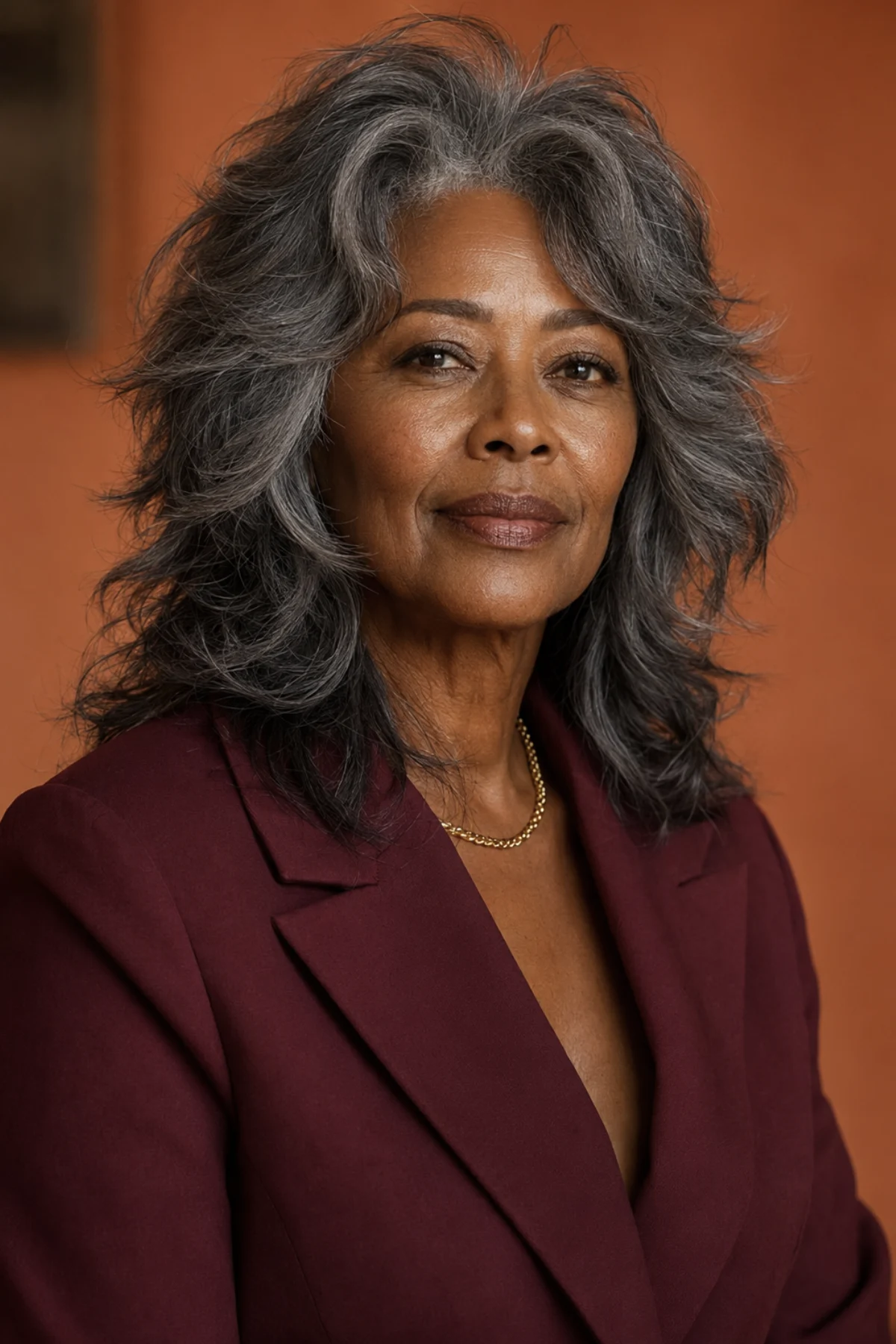
Your hair in your 60s is not the same hair you had at 40. The density is different. The texture is different. The way it holds a style is different. And that is not a problem to fix; it is just where you are, and the right cut works with all of it.
The three things most readers arriving here are carrying: hair that has gotten finer or thinner than it used to be, a gray transition they are either embracing or still figuring out, and a nagging sense that cuts that worked before just do not quite land anymore. All three are normal. None of them narrow your options as much as you might think.
This guide covers 25 haircuts for women over 60 organized by length, short through long, with each style broken down by what it actually does for your hair and your face. The face shape and hair texture sections at the bottom help you cross-reference quickly if you already know what you are working with. And every style includes a note on what to tell your stylist so you are not walking in with a vague idea and walking out with something different.
No age-defying promises here. Just cuts that genuinely work.
Quick Summary
Perfect For: Women over 60 with fine, thinning, gray, or changing-texture hair who want a cut that suits their hair as it is now, not as it was.
Maintenance: Ranges from very low (wash-and-wear pixie) to moderate (long layered cuts). Each style notes its maintenance level.
Best Hair Types: All hair types are covered, with dedicated sections for fine, thick, wavy, curly, and gray hair.
Best Face Shapes: All five major face shapes covered, including a dedicated face shape guide below.
Styling Difficulty: Most styles in this guide lean toward low to moderate. Heat tools are noted where useful, never assumed.
Why Hair Changes After 60
Hair follicles gradually shrink with age, a process called follicle miniaturization, which produces finer, lighter strands over time. Sebum production also drops, so hair tends to feel drier and may lose some of its natural shine. Gray hair is structurally different from pigmented hair: it tends to be coarser, more porous, and prone to frizz because it lacks the melanin that once gave strands some built-in flexibility.
What this means practically: a blunt, one-length cut that looked full and sleek in your 40s can look thin and flat now because there is less density to fill it out. Layers redistribute weight and create the appearance of volume. Shorter lengths reduce the pull of gravity on fine strands and generally require less daily upkeep. None of this means you have to go short. It means the cut has to do a bit more work than it used to.
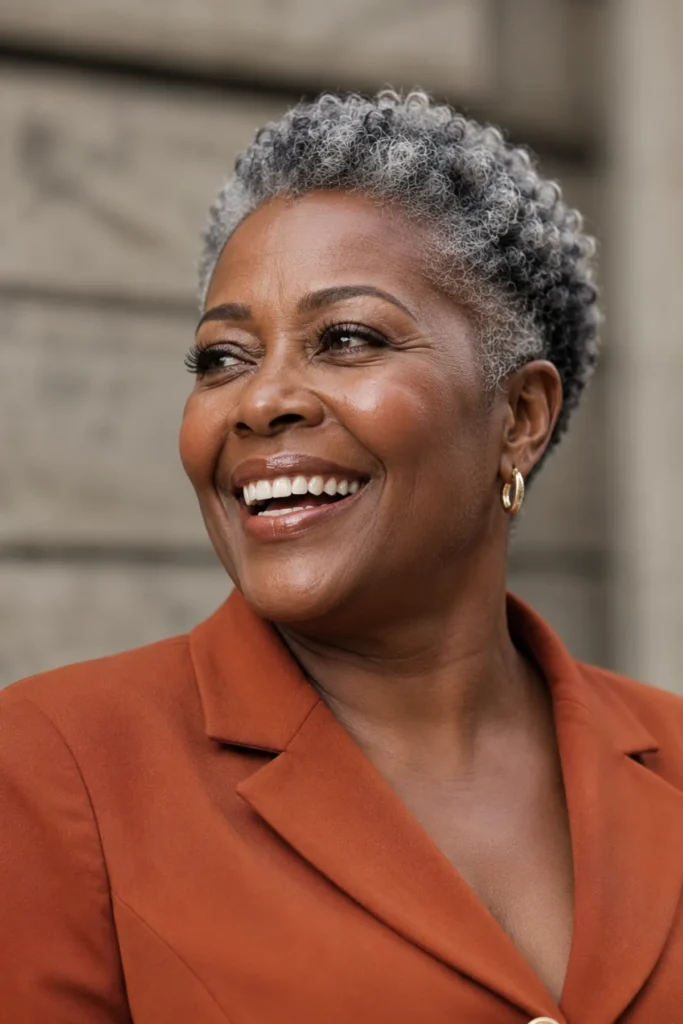
The good news is that most of the cuts below were chosen specifically because they work with these changes rather than fighting them. With that in mind, here are the 25 that genuinely deliver.
Not sure which cut is right for you? Browse our full guide to 25 Best Haircuts for Women Over 50 That Flatter Every Face Shape
Short Haircuts for Women Over 60
Short cuts get a bad reputation in this demographic, mostly because people picture one specific kind of short: rigid, over-set, stiff at the edges. That is a styling problem, not a length problem. Modern short cuts for women over 60 are about texture, movement, and softness. The right short cut can add volume at the crown, reduce daily styling time dramatically, and look far more current than anything that sits heavy and flat.
01. The Soft Layered Pixie
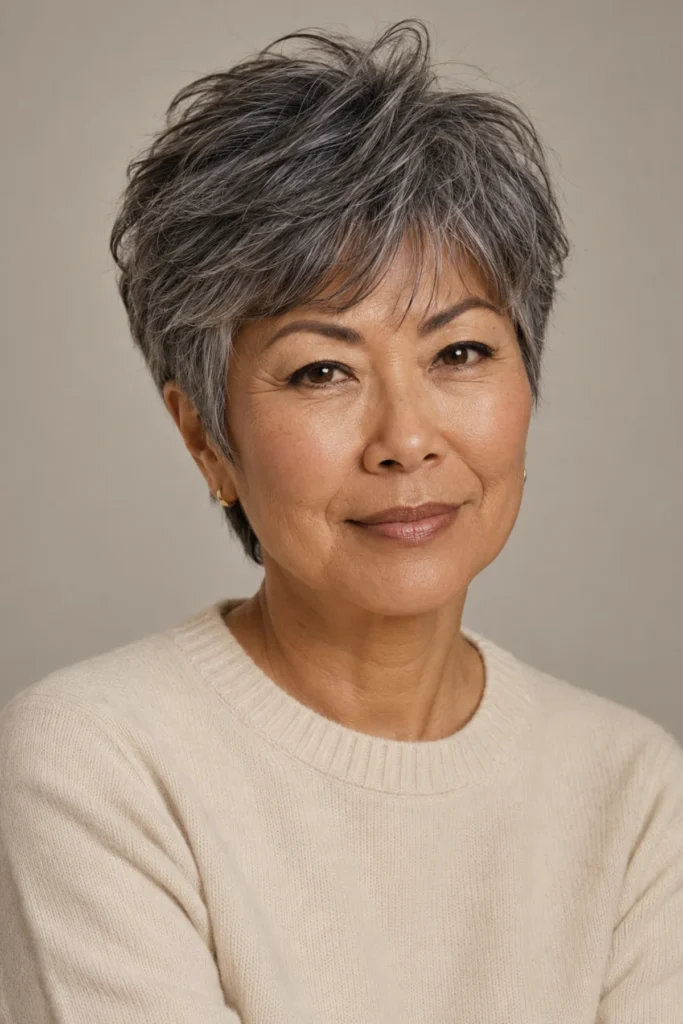
The soft layered pixie keeps more length at the crown than a traditional pixie, with feathered layers that taper gently at the sides and nape rather than cutting close. At 60-plus, the distinction matters: the extra crown length creates scalp coverage where fine hair thins first, while the feathering breaks up the silhouette so the cut never looks severe. On natural gray or silver hair, the variation in strand color adds depth that a blunter cut would flatten out entirely.
BEST FOR
- Fine or thinning hair
- Oval and square face shapes
- Low-maintenance lifestyles
- Gray and silver hair
Why It Works: The longer crown creates height and scalp coverage where fine hair most needs both. Feathered layers mean the cut moves even when the hair is minimal.
Styling Tip: Work a pea-sized amount of light-hold cream through damp hair, then air dry or use a diffuser on low heat. Heavy pomades will flatten the volume you are building.
Maintenance Level: Medium. Pixies need a trim every 5 to 6 weeks to stay in shape, but day-to-day styling takes under five minutes.
Salon Tip: Ask for “a soft layered pixie with a longer crown for coverage, feathered at the sides, and tapered at the nape rather than shaved.”
02. The Textured Crop
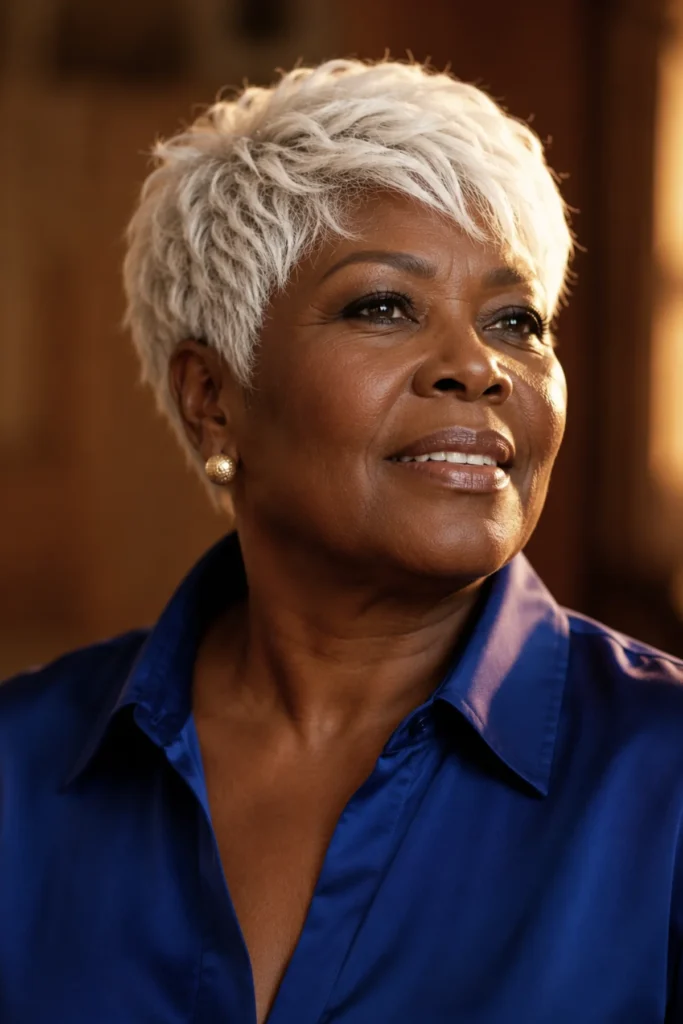
The textured crop is the right answer for women with thick or dense hair who want short but do not want to look overdressed for their own kitchen. Choppy, deliberate layers remove bulk without making the cut look thin, and a soft side-swept fringe softens the forehead without the maintenance commitment of full bangs. This cut dries quickly, holds its shape without much intervention, and grows out in a reasonably forgiving way between appointments.
BEST FOR
- Thick or coarse hair
- Round and rectangular face shapes
- Women who air-dry
Why It Works: Interior layers control weight, so thick hair does not puff outward. The choppy finish adds a modern quality without requiring daily styling.
Styling Tip: A small amount of texturizing paste worked through dry hair gives the layers definition and keeps them from merging into a single mass.
Salon Tip: Ask for “a textured crop with choppy interior layers and a soft fringe that sweeps to one side, nothing too sharp at the edges.”
Maintenance Level: Medium. Trim every 6 weeks to keep the layers working.
03. The Micro Pixie
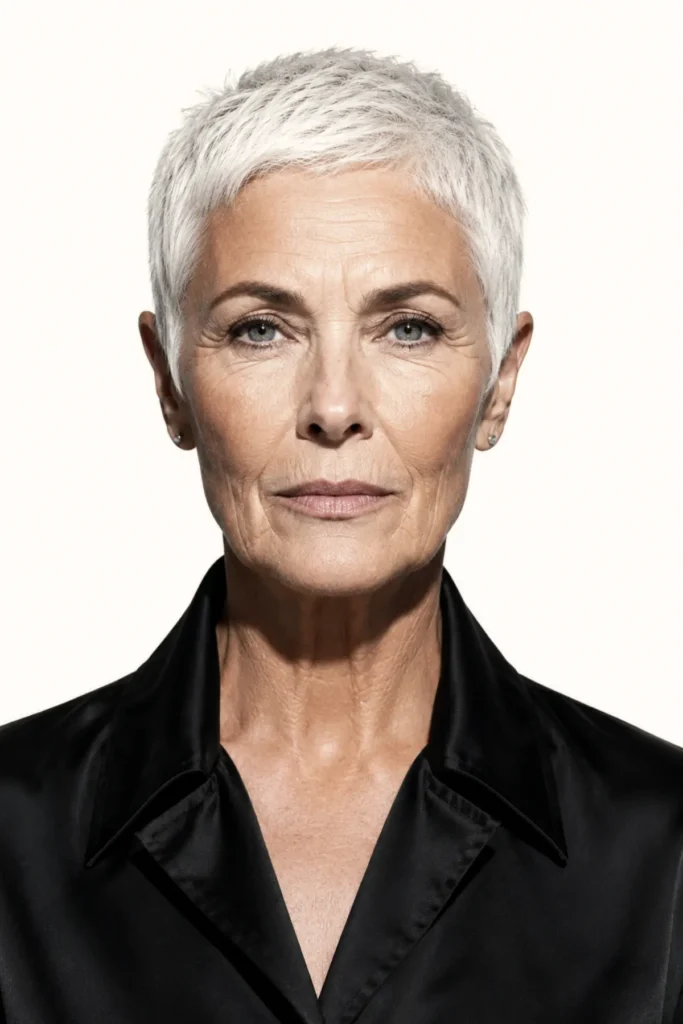
The micro pixie is cut shorter than a standard pixie throughout, with close-cropped sides, a slightly longer crown kept flat or barely lifted, and a clean taper at the nape. It is a decisive cut, and that is exactly the point. On natural white or bright silver hair, the shortness means every strand is visible and the color becomes the entire composition. This cut suits women who have made a clear decision about where they are and have no interest in hedging it with length.
BEST FOR
- Pure white or bright silver hair
- Oval and oblong faces
- Women who want minimum styling
- Active and outdoor lifestyles
Why It Works: At this length, scalp health is part of the aesthetic. The color and cut do all the work without any styling intervention.
Styling Tip: A light shine serum on the crown after drying is all this needs. Avoid anything with hold; the cut has its own structure.
Who Should Reconsider It: Women who want flexibility in how they wear their hair day to day. A micro pixie has one look, and it is a committed one.
Salon Tip: Ask for “a micro pixie, close-cropped throughout, slightly longer only at the crown, clean taper at the nape, no texture spray finish needed.”
Maintenance Level: High. Needs shaping every 4 to 5 weeks.
04. The Disconnected Bob
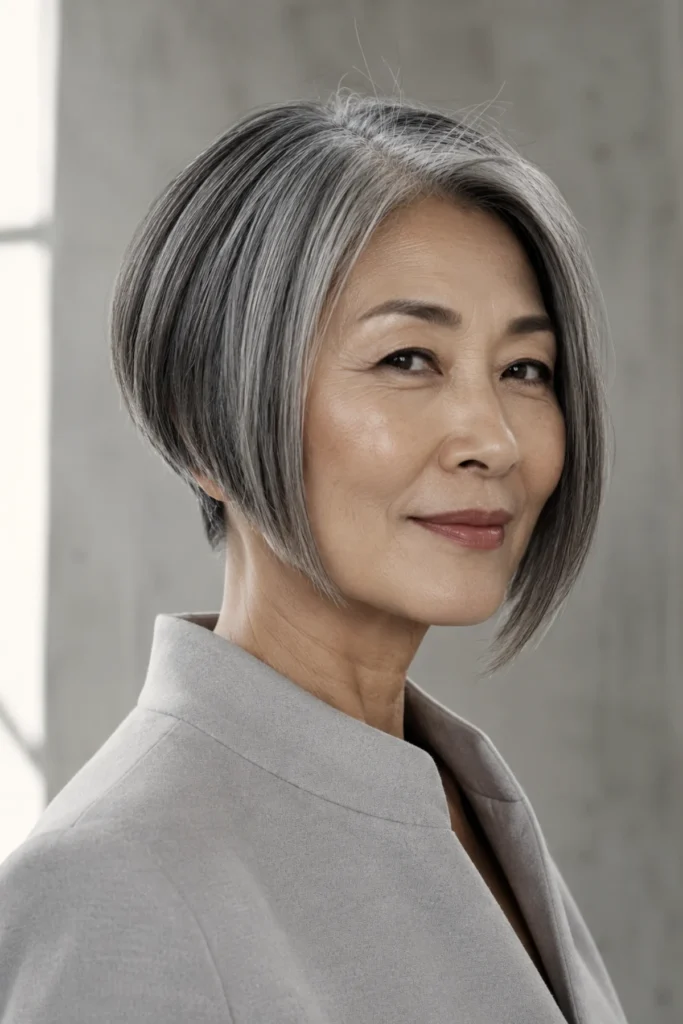
The disconnected bob has a clearly visible contrast between two sections: the front panels are left longer, falling to or below the jaw, while the back is cut considerably shorter, often to the nape or upper neck. Unlike a standard bob where the length graduates gradually, the disconnected version has a deliberate break between the two. That contrast creates a geometric quality that reads as directional on gray or salt-and-pepper hair, where the color shift across sections adds another layer of visual interest.
BEST FOR
- Square and oval faces
- Medium-density hair
- Women who want structure and a modern silhouette
- Natural gray or salt-and-pepper hair
Why It Works: The longer front panels soften the jaw and frame the face, while the closely cut back lifts the crown and nape visually. The contrast does the work; no styling required to make this cut look intentional.
Styling Tip: Blow-dry the front panels forward and slightly under. Leave the back to air-dry; its close cut holds shape without assistance.
Salon Tip: Ask for “a disconnected bob with front panels to the jaw and a significantly shorter back, with a clean break rather than a gradual graduation between the two lengths.”
Maintenance Level: Medium-high. The disconnection needs to stay clean to read correctly.
05. The Crown-Volume Bob
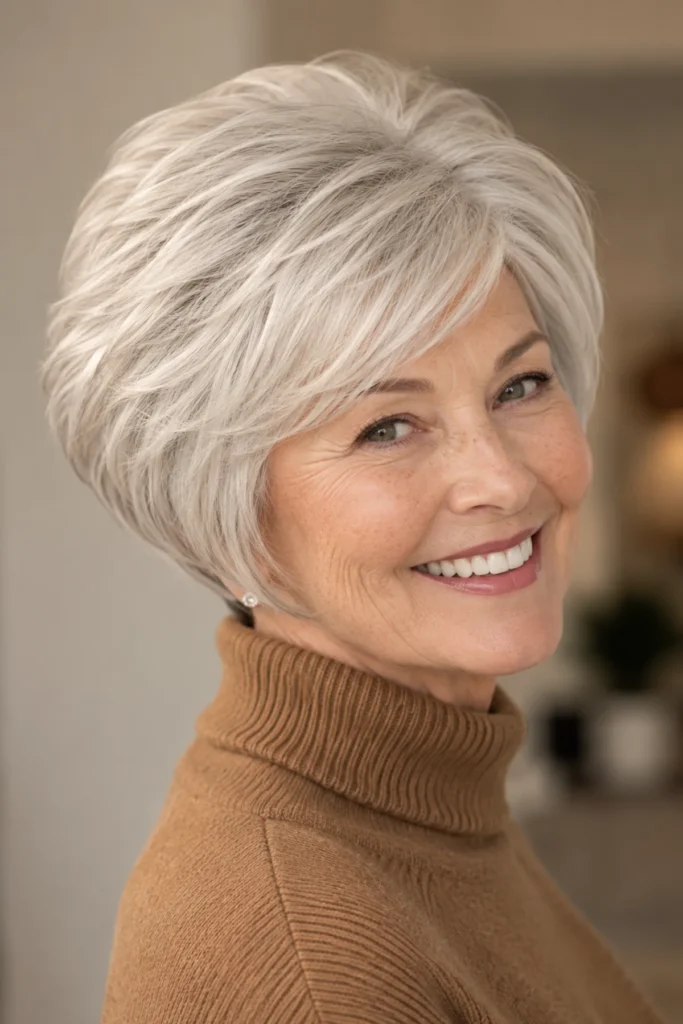
The crown-volume bob is built specifically around one problem that becomes more common after 60: fine hair that loses density at the top first. The cut is graduated, shorter at the nape and fuller at the crown, shaped into a rounded silhouette that stays elevated when blow-dried. The nape graduation removes the weight that pulls fine hair downward, while the rounded crown creates exactly the lift that fine hair cannot produce on its own.
BEST FOR
- Fine or thinning hair with visible crown loss
- Round and oval faces
- Women willing to blow-dry for the result
- Silver-white or pale gray hair
Why It Works: The graduation redirects the hair’s structure upward rather than letting gravity dictate the shape. The rounded crown is built into the cut, not dependent on product.
Styling Tip: Apply a root-lifting spray only at the roots before drying. Use a round brush at the crown, rolling upward and outward in sections. Finish each section with the cool shot on the dryer before releasing.
Salon Tip: Ask for “a graduated bob with maximum crown volume, shorter at the nape and building upward into a rounded shape, finished smooth.”
Maintenance Level: Medium-high. The graduation grows out within 5 to 6 weeks.
06. The Short Shag with Fringe
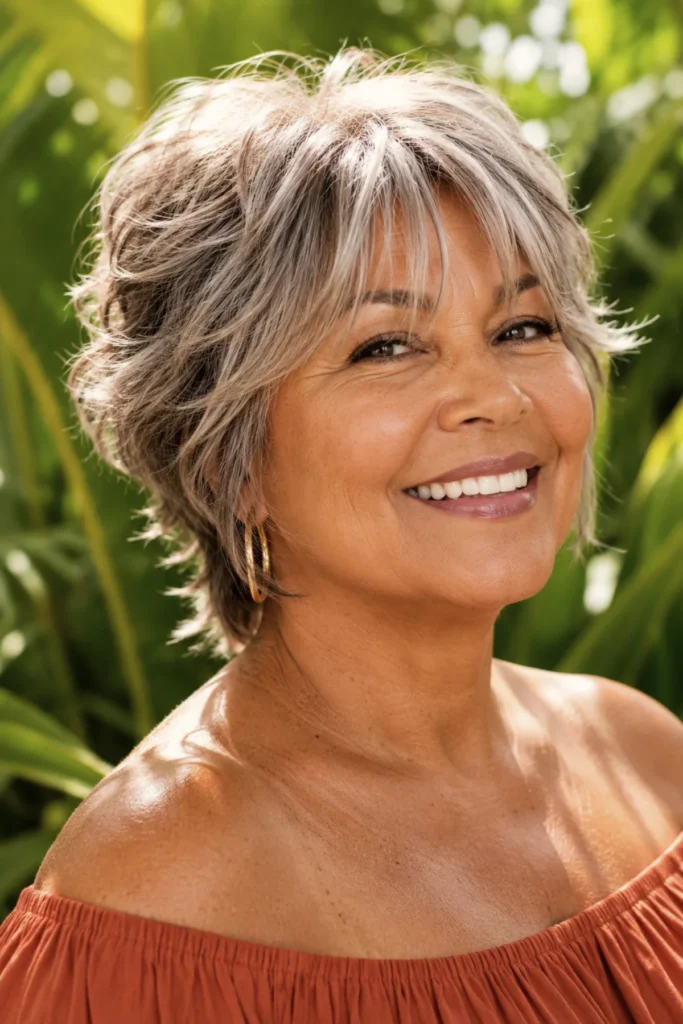
The shag is having a genuine moment, and its short version translates well to women over 60 because it was designed around texture and movement rather than precision. Feathered layers throughout, a wispy curtain fringe that parts in the middle and falls to the outer brow, and a deliberately undone finish. For gray hair with some coarseness, the shag embraces that texture rather than trying to smooth it away. It looks good air-dried, which is its main selling point.
BEST FOR
- Coarse or naturally textured hair
- Round and oval faces
- Low-heat styling preferences
- Gray hair embracers
Why It Works: The shag’s layered structure breaks up coarse or frizzy texture so it reads as intentional volume rather than a styling problem.
Styling Tip: Scrunch a curl-enhancing cream through damp hair and air dry. The less you touch it while it dries, the better the result.
Salon Tip: Ask for “a short shag with feathered layers, a wispy curtain fringe that can be parted in the middle, and a relaxed rather than structured finish.”
Maintenance Level: Low. The shag grows out well and gains character between appointments rather than losing it.
07. The Wash-and-Wear Pixie
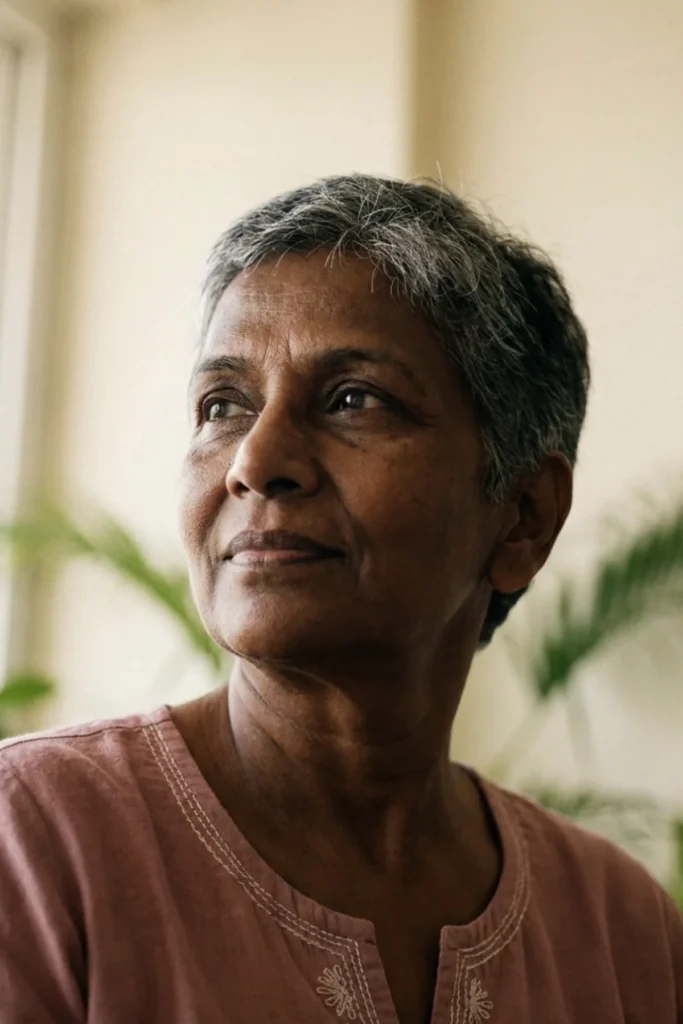
The wash-and-wear pixie is cut specifically for air drying, which means the layers and lengths are calibrated to fall into a good shape on their own. No round brush required. Towel off, run your fingers through it, and go. For coarse silver or salt-and-pepper hair, this cut leans into natural texture rather than trying to override it. The result looks like someone with good hair who does not spend much time on it, which is exactly the goal.
BEST FOR
- Coarse, wiry, or silver hair
- All face shapes
- Very low-maintenance lifestyles
- Women who avoid heat tools
Why It Works: The cut is designed around the hair’s natural behavior. Layers are placed where the hair moves on its own, not where a stylist’s blow-dry would put them.
Styling Tip: A small amount of light cream on damp hair is all this needs. Let it dry undisturbed.
Salon Tip: Ask for “a wash-and-wear pixie that air-dries well without styling tools, with layers placed for my natural texture rather than a blow-dry finish.”
Maintenance Level: Low. One of the easiest cuts in this guide to live with between appointments.
08. The Undercut Bob
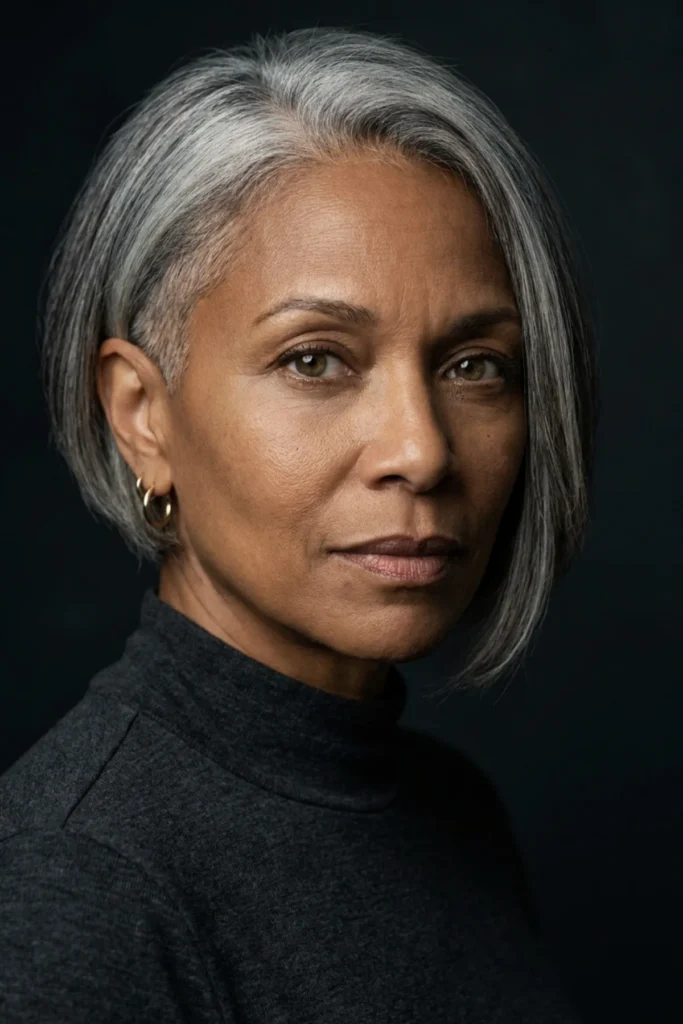
The undercut bob stacks layers at the back for volume and lift, tapers closely at the nape, and keeps longer pieces at the front to frame the face. For women with square or defined jaw shapes, the contrast between the shorter back and the longer front pieces softens the jaw and draws attention upward. It reads as deliberate and modern without being the kind of cut that announces itself.
BEST FOR
- Square and oval faces
- Medium to thick hair
- Women who want structure
Why It Works: The stacked back creates a lifted silhouette that does not rely on volume at the crown alone, while the front pieces frame rather than hide the jaw.
Styling Tip: Blow-dry the back sections upward with a round brush to maximize the stacked volume. Let the front pieces air dry for a softer contrast.
Salon Tip: Ask for “an undercut bob with stacking at the back, a tapered nape, and longer face-framing pieces at the front that fall below the jaw.”
Maintenance Level: Medium-high. The undercut needs regular attention to stay sharp.
09. The Short Rounded Bob
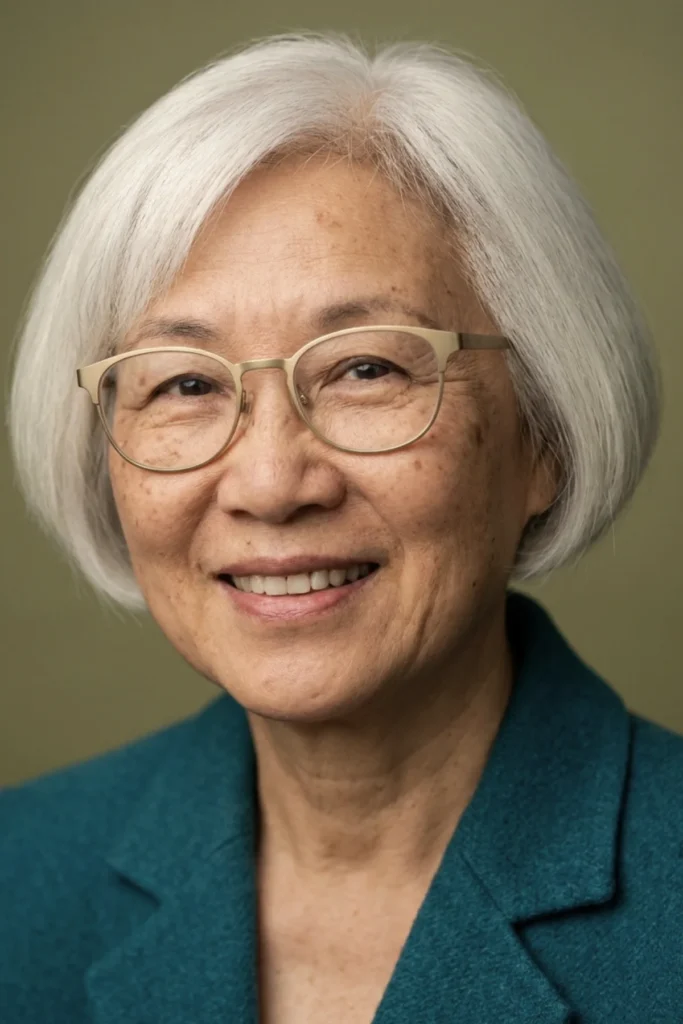
The rounded bob is cut with a curved hem rather than a flat horizontal line, which gives fine hair the appearance of more fullness without relying on volume product alone. It sits just below the jaw, curves slightly under at the ends, and works best with a smooth finish. For women with fine gray or white hair, the rounded silhouette is more forgiving than a blunt-ended bob, which can look sparse at the hem if the hair is thin.
BEST FOR
- Fine or white hair
- Round and oval faces
- Classic, polished aesthetics
Why It Works: The curved hem creates the visual impression of density at the ends, which is exactly where fine hair tends to look thinnest.
Styling Tip: Blow-dry with a paddle brush, rolling the ends very slightly under on the last pass. A light volumizing spray at the roots before drying adds lift without stiffness.
Salon Tip: Ask for “a rounded bob just below the jaw, beveled ends that curve slightly under, and a smooth finish without internal layers.”
Maintenance Level: Medium. Every 7 to 8 weeks to maintain the rounded shape.
Medium-Length Haircuts for Women Over 60
Medium-length cuts, anything from the chin down to the collarbone, are the most versatile category for women over 60. There is enough length to create movement, layers, and face-framing, but not so much weight that fine hair collapses or thick hair takes over. This range is where the most distinctive and varied cuts live for this demographic, from sharp geometric angles to relaxed lived-in shags.
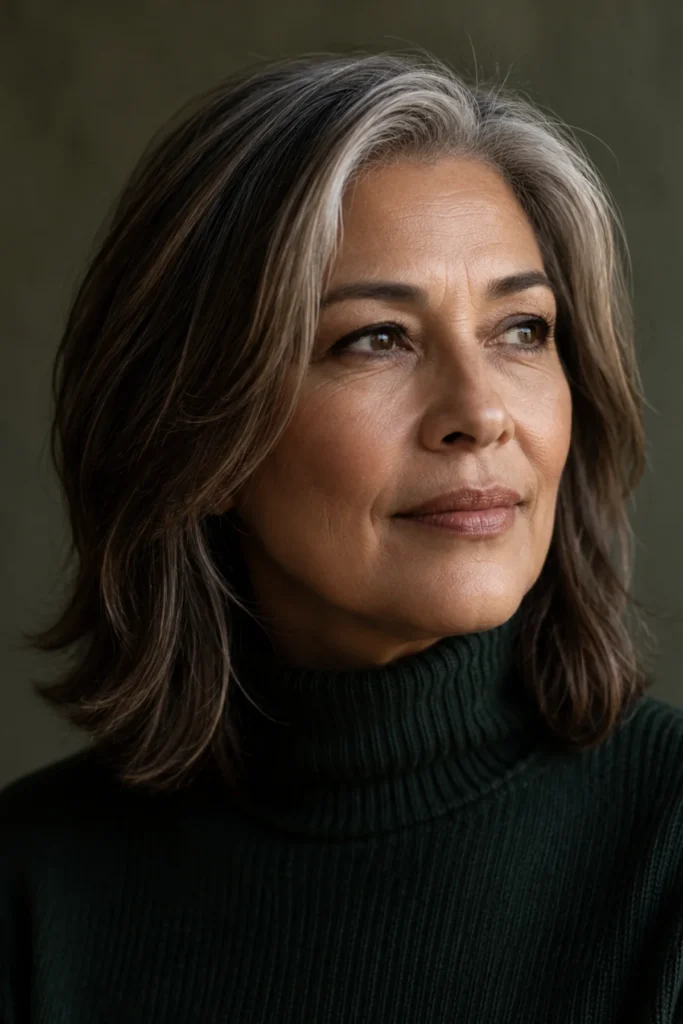
10. The Soft Layered Bob
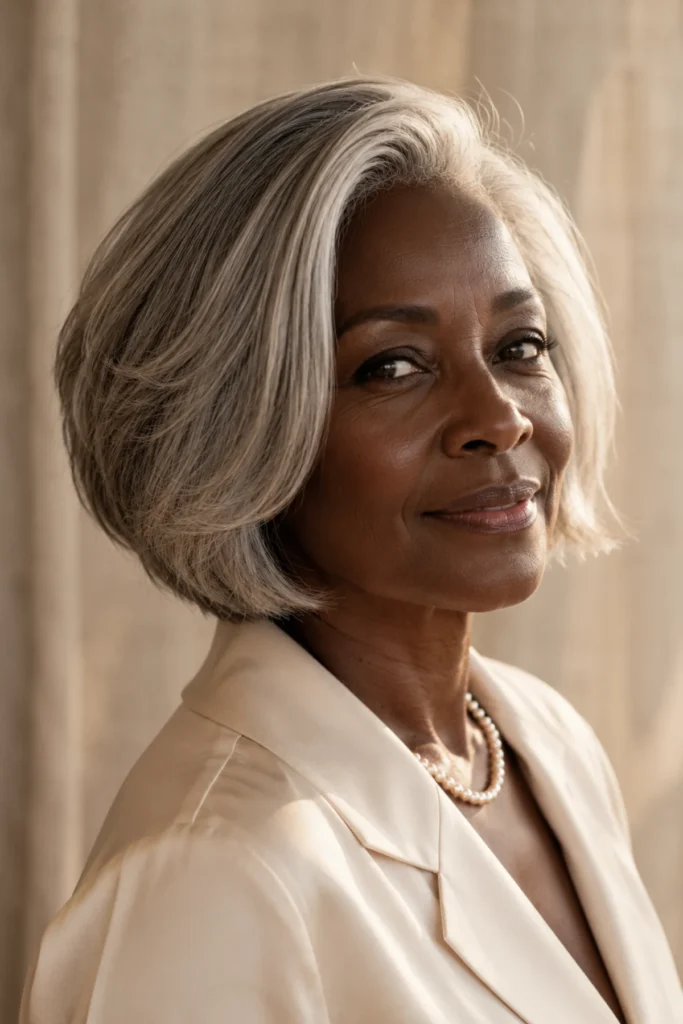
The soft layered bob is the workhorse of this list. It suits more face shapes and hair types than almost any other cut here, it photographs well, and it grows out gracefully. Chin-length with soft layers that start a few inches above the ends, a natural side part, and movement that does not require a blow-dry to be visible. On silver hair, the layers add dimension to what can otherwise read as flat color.
BEST FOR
- Most face shapes
- Fine to medium hair
- Gray and silver hair
- First-time bob wearers
Why It Works: Soft layers create internal movement without removing length, which makes the hair look fuller while staying manageable.
Styling Tip: Air-dry for a relaxed finish or diffuse on low heat for more volume. A wide-tooth comb through damp hair sets the layers in the right direction without over-manipulating them.
Salon Tip: Ask for “a soft layered chin-length bob with a natural side part, layers starting about halfway down, nothing blunt at the ends.”
Maintenance Level: Low-medium. One of the most forgiving cuts to grow out between appointments.
11. The Chin-Length Bob with Side-Swept Fringe
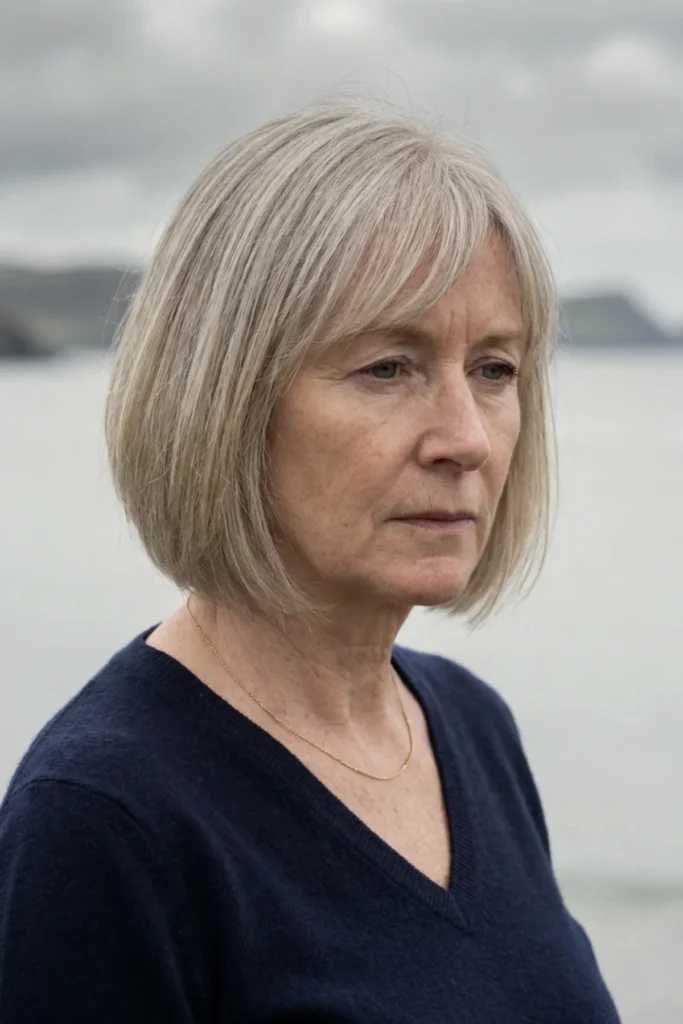
Adding a side-swept fringe to a chin-length bob does two things: it frames the forehead softly and it creates a diagonal line across the face that suits rectangular and square face shapes particularly well. The fringe does not need to be heavy. A light, tapered version that sweeps from a deep left or right part and blends into the length is all it takes. For fine gray-blonde hair, the fringe adds a visual anchor that a plain bob sometimes lacks.
BEST FOR
- Rectangular and square faces
- Fine hair
- Women who like a polished finish
Why It Works: The diagonal of the fringe interrupts the vertical length of a rectangular face and creates gentle asymmetry that softens a square jaw.
Best Face Shapes: Rectangular and square faces benefit most. Works less well on heart shapes, where a fringe can crowd a narrow chin.
Styling Tip: Blow-dry the fringe with a round brush, directing it to one side. A tiny amount of wax at the tips keeps it from floating.
Salon Tip: Ask for “a chin-length bob with a side-swept fringe from a deep part, tapered at the ends so it blends into the length rather than sitting on top.”
Maintenance Level: Medium. The fringe needs trimming every 4 to 5 weeks to stay in the right range.
12. The Blunt Collarbone Cut
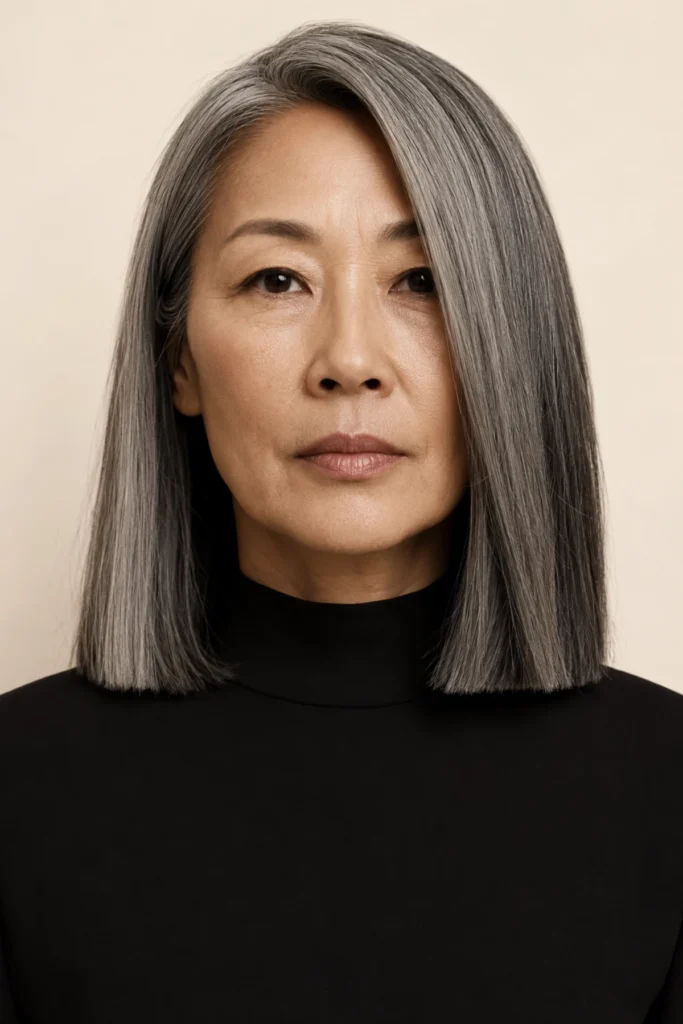
Where most cuts in this guide use layers to manage changing hair, the blunt collarbone cut takes the opposite position. One length, a precise hem at the collarbone, a center or deep side part, and no internal layering. It requires medium to thick hair with enough density to fill the hem cleanly, but when the density is there, the result is striking. The precision of the cut is the style. On dark silver or charcoal gray hair, the single clean line at the collarbone reads as intentional and very current.
BEST FOR
- Medium to thick hair with good density
- Oval and oblong faces
- Women who want a strong, clean silhouette
- Dark silver or charcoal gray hair
Why It Works: The blunt hem at the collarbone creates a horizontal line that adds width and visual weight exactly where collarbone-length sits on the frame, which suits oval and oblong faces well.
Who Should Reconsider It: Fine hair. Blunt ends reveal sparse density at the hem. The Crown-Volume Bob (#05) or Soft Layered Bob (#10) serve fine hair better.
Styling Tip: A paddle brush blow-dry on the lowest heat setting, brushing downward in sections, produces the smooth finish this cut relies on.
Salon Tip: Ask for “a blunt one-length cut at the collarbone, no interior layering, precision scissor-cut hem rather than point-cut ends.”
Maintenance Level: Medium. The blunt hem shows growth clearly within 6 to 8 weeks.
13. The Side-Parted Shaggy Lob
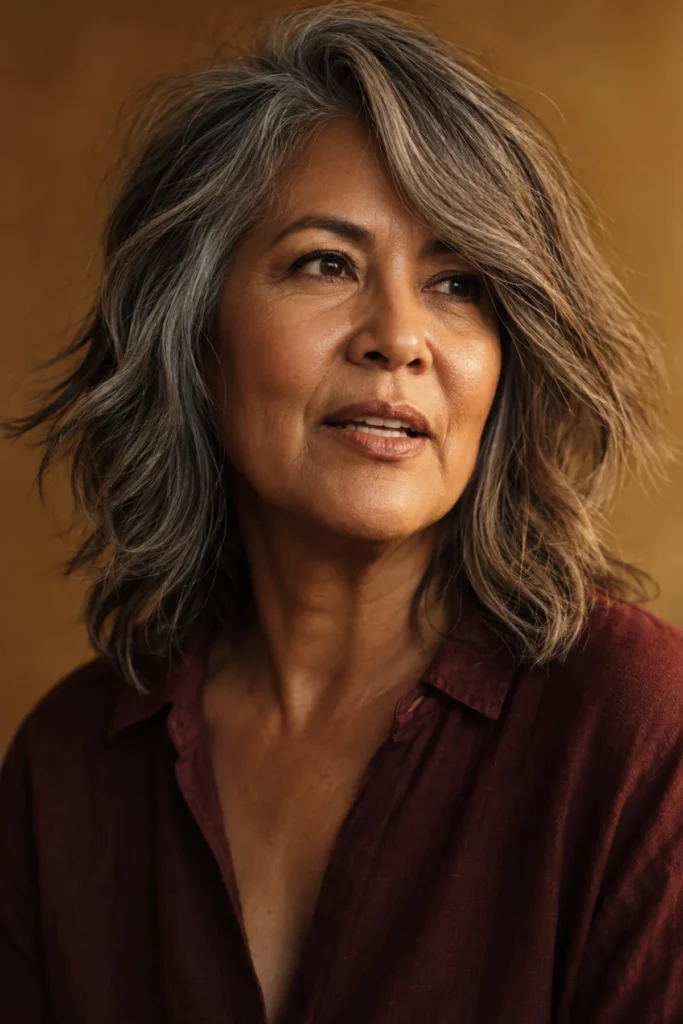
The shaggy lob is a lob with the shag’s layering logic applied: feathered ends, visible movement throughout, and a finish that looks better on day two than it did on day one. What distinguishes the side-parted version is the deep, off-center part, which creates an asymmetric sweep of hair across the face that softens a square jaw or balances a wide forehead. The combination of shag movement and asymmetric parting makes this one of the most face-adaptable cuts in the medium-length category.
BEST FOR
- Square and heart faces
- Medium-density hair with natural texture
- Women who prefer lived-in over polished
- Silver-brown or warm gray hair
Why It Works: The deep side part and shag layers together create diagonal movement across the face, which interrupts strong or angular face shapes in a flattering way.
Styling Tip: Blow-dry quickly with your fingers using a diffuser, then push the part to one side and leave it. The shag layers will settle into shape within an hour of drying.
Salon Tip: Ask for “a shaggy lob with feathered ends and layers starting at the chin, styled with a deep asymmetric side part rather than a center or natural part.”
Maintenance Level: Low. One of the easiest medium-length cuts to grow out without appointments.
14. The Asymmetrical Lob
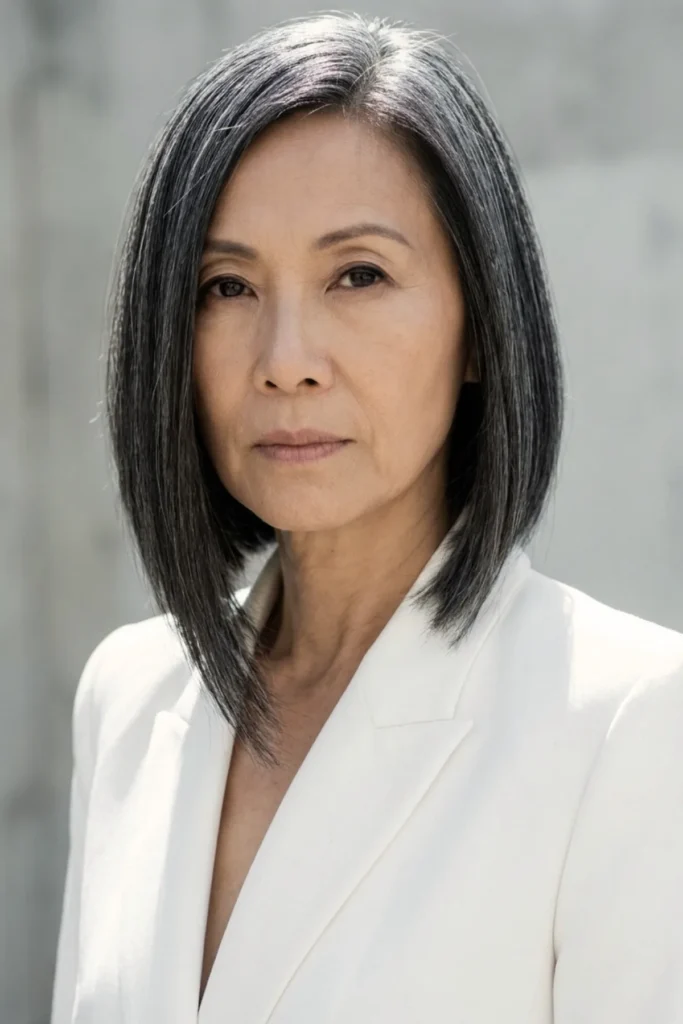
The asymmetrical lob is cut longer on one side and shorter on the other, with a clean diagonal angle connecting them. The difference does not have to be dramatic; even an inch of variation creates real visual interest. For oval face shapes, the asymmetry adds movement and character without needing to rely on styling. On charcoal or dark gray hair, the clean angle reads as sculptural.
BEST FOR
- Oval faces
- Medium-density hair
- Women who want a more directional look
Why It Works: Asymmetry creates visual movement in the haircut itself, so the style reads as intentional even straight from an air dry.
Styling Tip: Run a flat iron through the hair, alternating the direction of the bend every few inches, to keep the shape feeling loose rather than rigid.
Salon Tip: Ask for “an asymmetrical lob, longer on one side by about an inch, with a clean angle rather than a gradual taper.”
Maintenance Level: Medium. The angle needs to stay clean, so plan for every 8 weeks.
15. The Medium-Length Shag

At medium length, the shag becomes something slightly different from its short counterpart. More layers to work with, more movement, and the fringe can be more expressive. Coarse or thick silver hair is the ideal candidate: the shag’s structure breaks the density into sections that move independently, which is far more flattering than a solid curtain of hair. The lived-in texture requires minimal styling and looks intentionally undone rather than unstyled.
BEST FOR
- Coarse, thick, or naturally textured hair
- Oval and rectangular faces
- Women who prefer low-effort styling
Why It Works: The shag removes bulk from thick hair in a way that creates movement rather than a blunt hemline, which is the difference between “I cut my hair” and “I got a haircut.”
Styling Tip: Scrunch with a leave-in conditioner while damp and let it air dry completely before touching. Diffusing on low heat works if you want slightly more volume.
Salon Tip: Ask for “a medium-length shag with feathered layers throughout, a wispy fringe, and a finish that will air-dry without looking messy.”
Maintenance Level: Low. One of the best cuts for growing out naturally.
16. The Layered Bob with Face-Framing Pieces
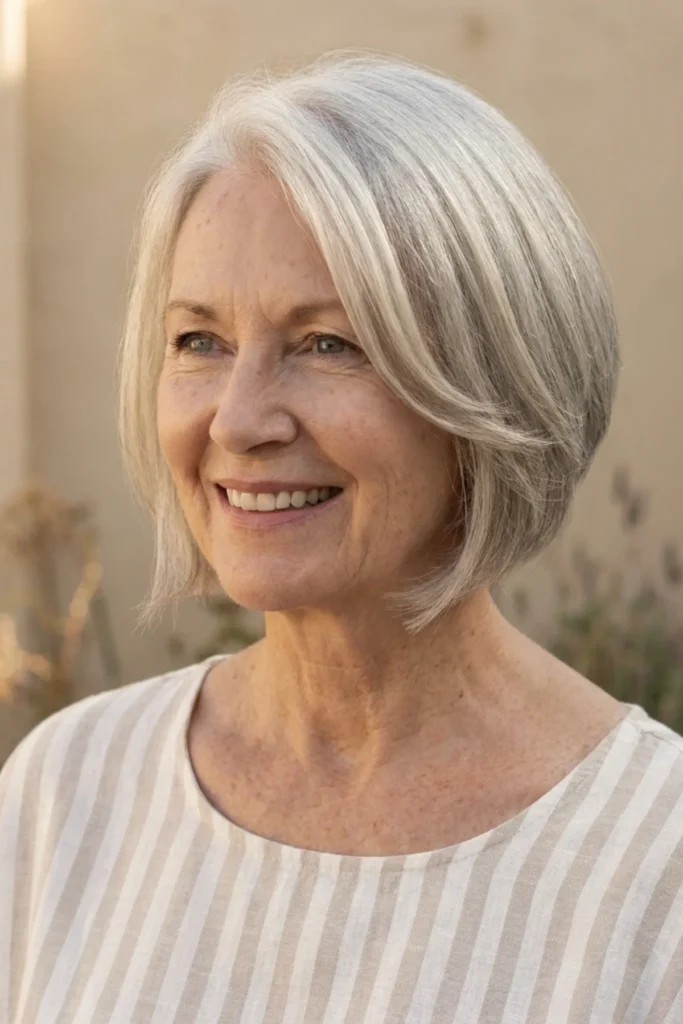
The layered bob with face-framing pieces is essentially a standard layered bob with two or three slightly longer, angled pieces pulled forward from the temples to frame the face. Those front pieces create a softening effect around the cheekbones and jaw that a uniform bob does not have. For fine gray-white hair, these pieces are one of the most effective ways to add interest and dimension without relying on color.
BEST FOR
- Fine or gray-white hair
- Heart and oval faces
- Women who want face-framing without fringe
Why It Works: The longer front pieces draw attention toward the center of the face, which lifts the overall look and creates the impression of more structure than the hair density alone provides.
Styling Tip: Blow-dry the face-framing pieces forward and slightly under. This is the one part of the style worth using a round brush on.
Salon Tip: Ask for “a layered bob with two or three face-framing pieces pulled forward from the temples, longer than the rest of the layers, angled toward the chin.”
Maintenance Level: Low-medium.
17. The A-Line Bob
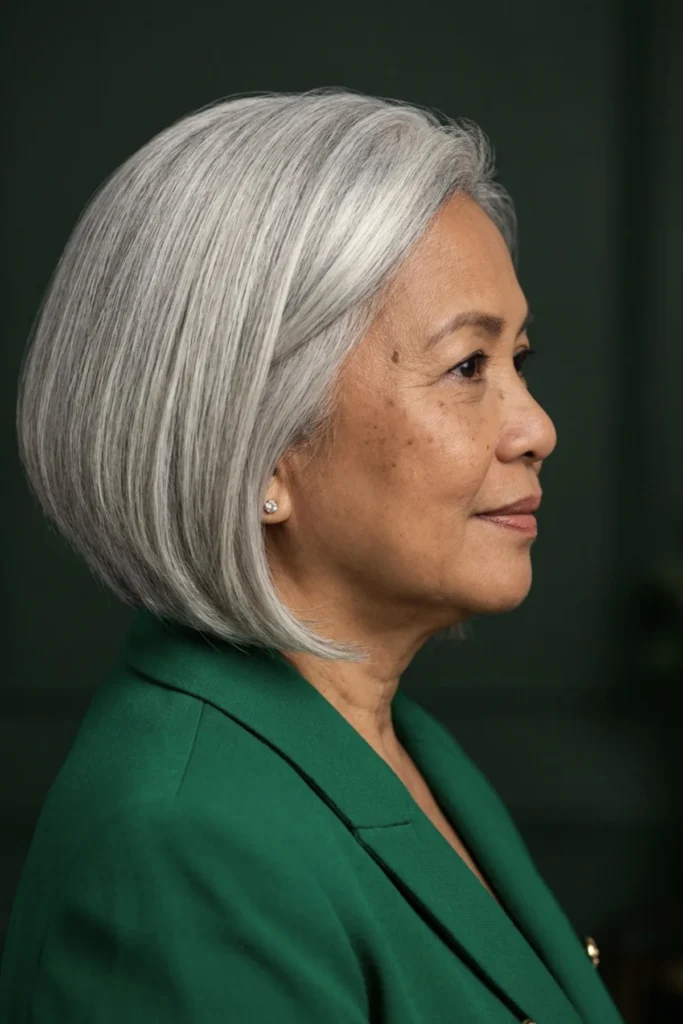
The A-line bob is longer at the front and shorter at the back, creating an angled line when viewed from the side. It is a cut that suits women who want the feel of a bob but prefer more length at the face. The clean angle is the style; this is not a cut for heavy layering. For natural silver hair, the smooth finish allows the color variation across the strands to become the visual interest.
BEST FOR
- Round and oval faces
- Medium-density hair
- Women who like a polished silhouette
Why It Works: The longer front pieces at the face create a slimming line downward, while the shorter back keeps the overall silhouette light.
Best Face Shapes: Works particularly well on round faces because the angled front creates a diagonal line that counters the circular shape.
Styling Tip: A smooth blow-dry with a paddle brush gives the best result. This cut does not benefit from tousling.
Salon Tip: Ask for “an A-line bob, longer at the front falling to the jaw, shorter at the back with a clean angle, minimal interior layering.”
Maintenance Level: Medium. The angle needs to stay clean.
18. The Wavy Bob for Naturally Textured Hair

For women with naturally wavy gray hair, the instinct is sometimes to fight the texture with a smooth blow-dry. This cut goes the other direction. The wavy bob is shaped to enhance whatever wave is already there, with a cut that removes length-weight while keeping enough mass for the waves to form properly. Air-dried or diffused on low heat, it looks relaxed without looking unstyled.
BEST FOR
- Naturally wavy hair
- Rectangular and oval faces
- Women who want to use their texture rather than suppress it
Why It Works: Working with natural wave rather than against it means less daily effort, less heat damage, and a result that actually improves over time as you learn how your hair moves.
Styling Tip: Apply a curl-enhancing cream to soaking-wet hair, scrunch from the ends upward, and leave it alone. Diffuse only if you want more volume.
Salon Tip: Ask for “a bob shaped for wavy hair specifically, not a standard bob cut on wavy hair. The layers need to account for where the wave begins, not just how long the hair is when dry.”
Maintenance Level: Low. Wavy bobs are forgiving as they grow.
19. The Wolf Cut at Shoulder Length
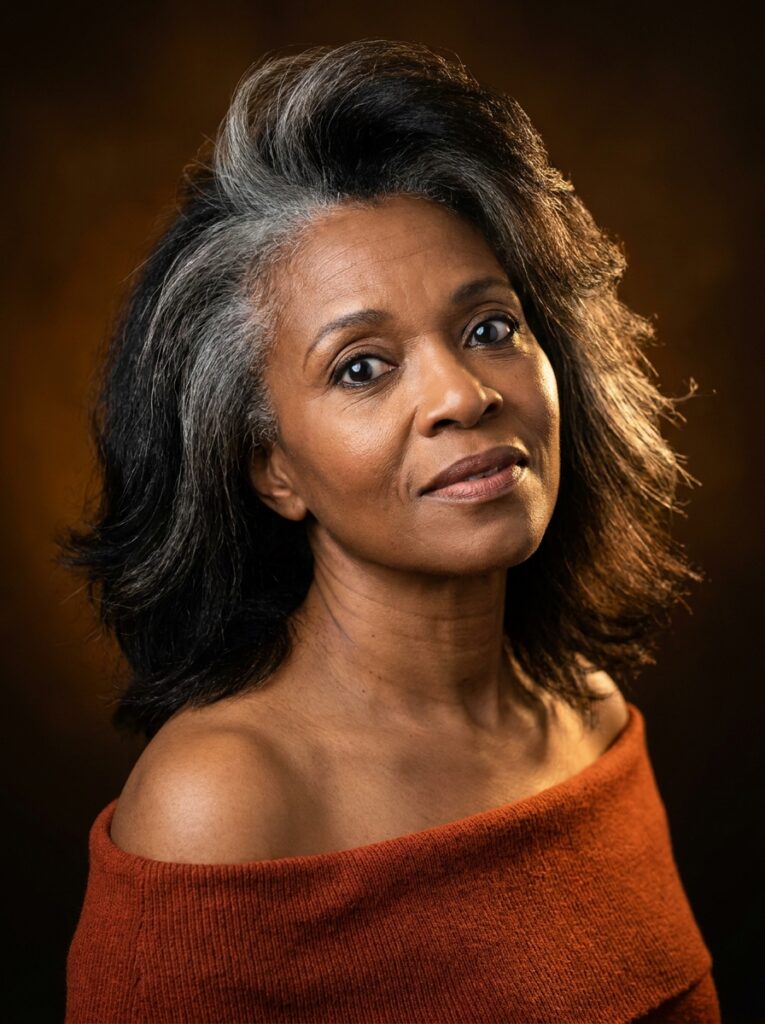
The wolf cut combines the crown volume of a mullet with the feathered layers of a shag, producing a style with dramatic contrast between a full, lifted top section and lighter, layered lengths below. At shoulder length, it is less extreme than its shorter versions and more wearable for everyday life, but it retains the distinctive silhouette. For silver-brown or transitional gray hair, the layering at the crown catches light in a way that makes the color variation genuinely visible.
BEST FOR
- Medium-density hair with natural texture or wave
- Oval and heart faces
- Women who want visible structure and movement
- Women in gray transition with mixed pigment
Why It Works: The heavy crown layering creates lift and volume at the top while the feathered ends keep the length from feeling heavy. The silhouette is modern without being costume-y at shoulder length.
Styling Tip: Diffuse on medium heat for the best result. The crown layers need some volume boost to separate, and the diffuser does this without flattening the ends.
Salon Tip: Ask for “a wolf cut at shoulder length, heavy layering through the crown section, feathered ends, and a finish that works air-dried or with a diffuser.”
Maintenance Level: Low-medium. Grows out into a standard layered cut without looking unkempt.
Long Haircuts for Women Over 60
Long hair is not off the table. The assumption that women past 60 should go short has no real basis in what actually looks good. What long hair does require is the right cut. Single-length long hair with no layers tends to look flat, heavy, and to drag the face downward. Long hair with well-placed layers has movement, lightness, and a quality that reads as intentional. These seven cuts all have layers as their starting point.
20. Soft Layers on Long Hair
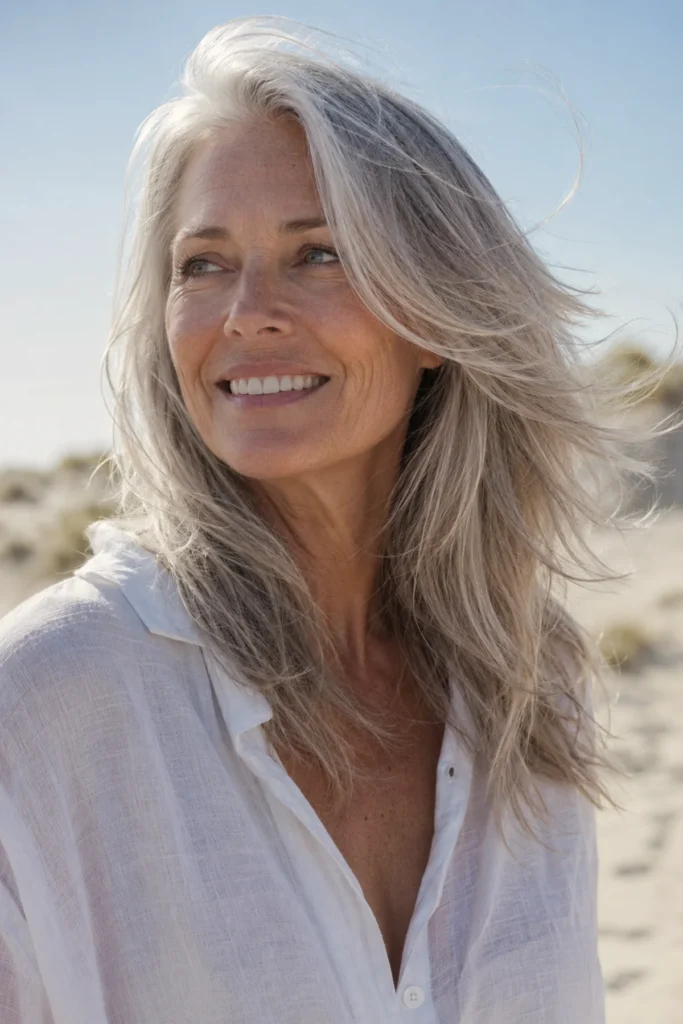
Soft layers on long hair are the most straightforward intervention for women who love their length but feel like their hair has stopped working the way it used to. The layers start at the chin and work downward, keeping the ends fuller while removing weight higher up. The result is hair that moves when you move, rather than sitting in a single weighted sheet. For silver hair past the collarbone, the layering allows the color variation across strands to be visible throughout the length rather than merging into one flat tone at the ends.
BEST FOR
- Oval faces
- All hair densities, adjusted by layer depth
- Women committed to their length
Why It Works: Layers break up the gravitational pull on long hair, which is what causes it to look flat against the face as density decreases.
Styling Tip: A light sea salt spray on damp hair, air-dried, gives soft layers real texture. If you prefer a smoother look, a round brush and low heat works equally well.
Salon Tip: Ask for “long layers starting at the chin with no heavy thinning at the ends. Keep the ends full, just remove weight in the middle.”
Maintenance Level: Low-medium. Trim every 10 to 12 weeks.
21. The Long Shag
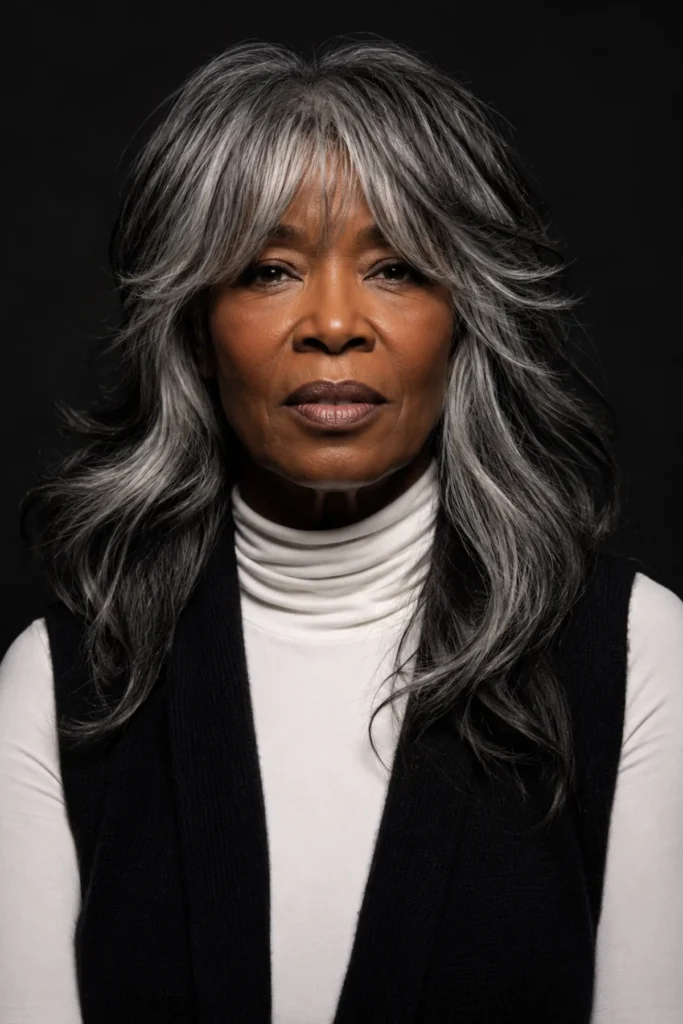
At its longer length, the shag becomes one of the best cuts for coarse, high-volume gray hair because it channels all that texture into something directional. Long layers throughout the length, a curtain fringe, and ends that are deliberately uneven rather than hemmed in a straight line. For women who have a lot of hair and find most cuts end up looking heavy and dense, the long shag redistributes rather than removes volume.
BEST FOR
- Coarse or very thick gray hair
- Square and oval faces
- Women who like a directional, editorial look
Why It Works: The long shag uses the hair’s own density as a feature. Each layer section becomes independent, so the hair falls in sections rather than as a single block.
Styling Tip: Scrunch with a light foam mousse on damp hair. Air dry and resist touching it. This cut rewards patience during drying.
Salon Tip: Ask for “a long shag with layers throughout, a curtain fringe, and razor-cut ends for softness rather than a scissor hem.”
Maintenance Level: Low. The shag grows out as well at long lengths as at short ones.
22. The Full Fringe Lob
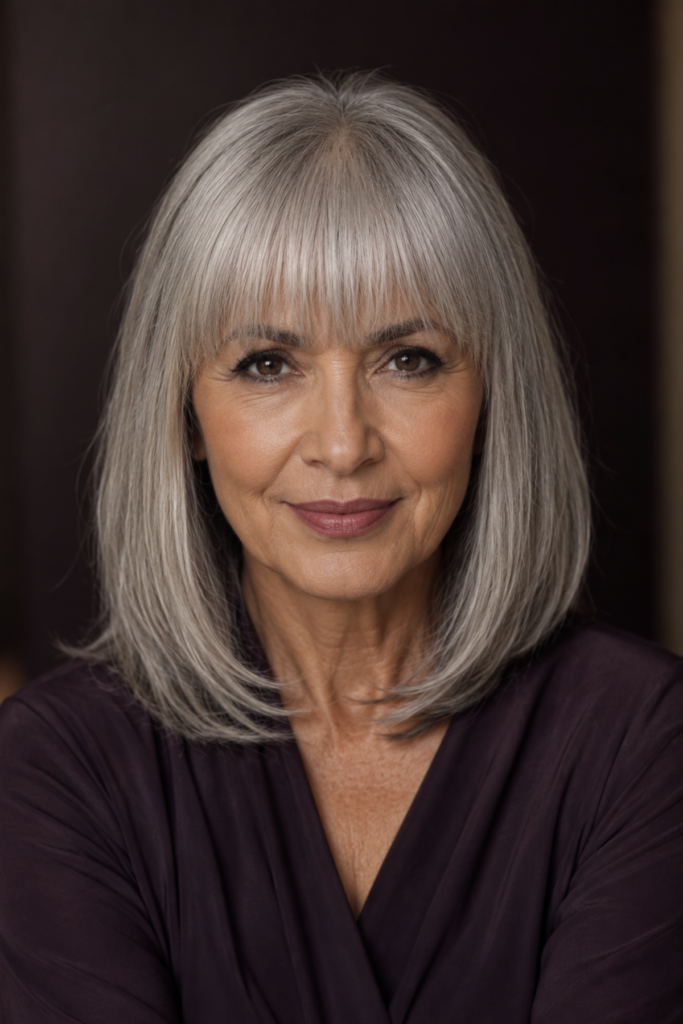
The full fringe lob takes the collarbone-length cut in a completely different direction from soft or wispy bangs. The fringe here is a deliberate, full-width statement that lands straight across the brow. On fine gray hair, the fringe creates a horizontal focal point that draws the eye immediately upward, which changes the whole proportion of the face. It is a commitment, but it is also one of the most distinctive combinations available at this length and one that reads as very intentional.
BEST FOR
- Oblong and oval faces
- Fine to medium hair
- Women who want a strong, distinctive look
- High foreheads
Why It Works: A full fringe shortens the visual length of an oblong or long face more effectively than any other single adjustment. Combined with a lob, the overall frame is both structured and wearable.
Who Should Reconsider It: Round faces, where a full fringe sitting at the brow reduces the vertical length that round faces need. Curtain bangs are a better option.
Styling Tip: The fringe is the part of this cut that needs the most daily attention. Blow-dry it first, using a small round brush to direct it straight and forward before moving to the rest of the hair.
Salon Tip: Ask for “a collarbone-length lob with a full fringe landing at the brow, cut straight across and blended into the side sections rather than an abrupt line.”
Maintenance Level: High for the fringe; low for the lob. Plan for fringe trims every 4 to 5 weeks.
23. Romantic Waves on Long Hair
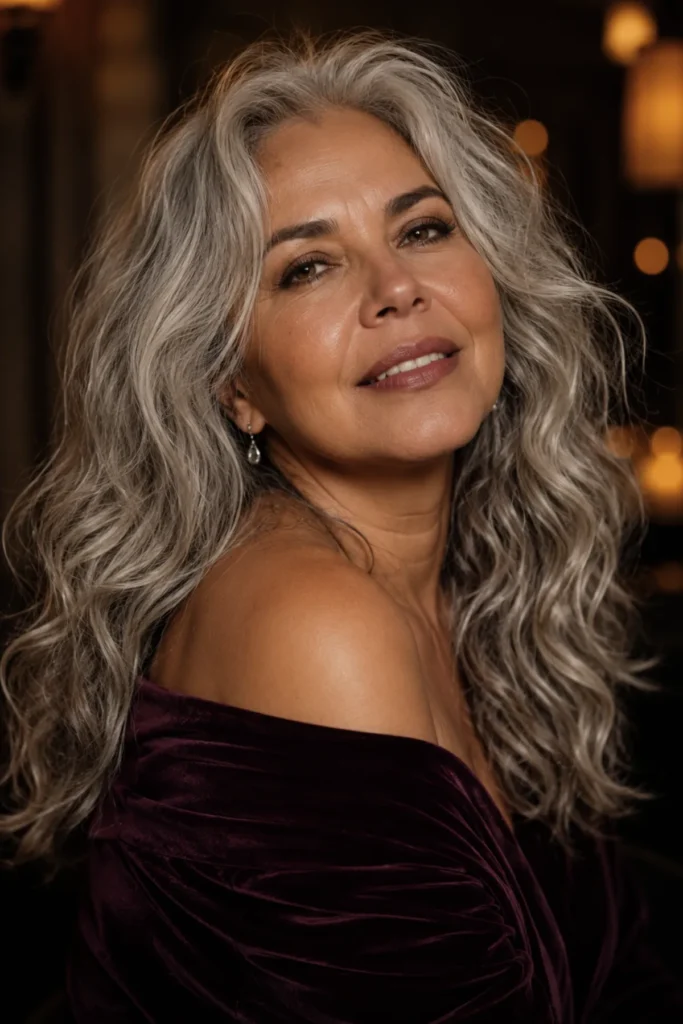
Romantic waves are the natural state of naturally wavy long hair when it has been cut to suit its own texture and left to do what it does. Not curls, not waves set with a wand, just the loose, slightly undulating movement that wavy hair produces when it is healthy and well-layered. For naturally wavy silver hair, this is possibly the most flattering option because the silver reads as luminous when the hair has movement and volume.
BEST FOR
- Naturally wavy hair
- Round and oval faces
- Women with thicker or denser hair
Why It Works: Romantic waves create natural volume and movement that adds life to longer hair, particularly silver or salt-and-pepper tones that tend to look flat when straight.
Styling Tip: The less you do, the better. A light leave-in conditioner on damp hair, a loose scrunch, and patience. Touching it while it dries is what causes frizz.
Salon Tip: Ask for “long layers designed specifically for wavy hair, starting higher up than standard, to allow the wave to form closer to the root.”
Maintenance Level: Low. Wavy cuts are among the easiest to maintain.
24. The Long Layered Cut for Thick Hair
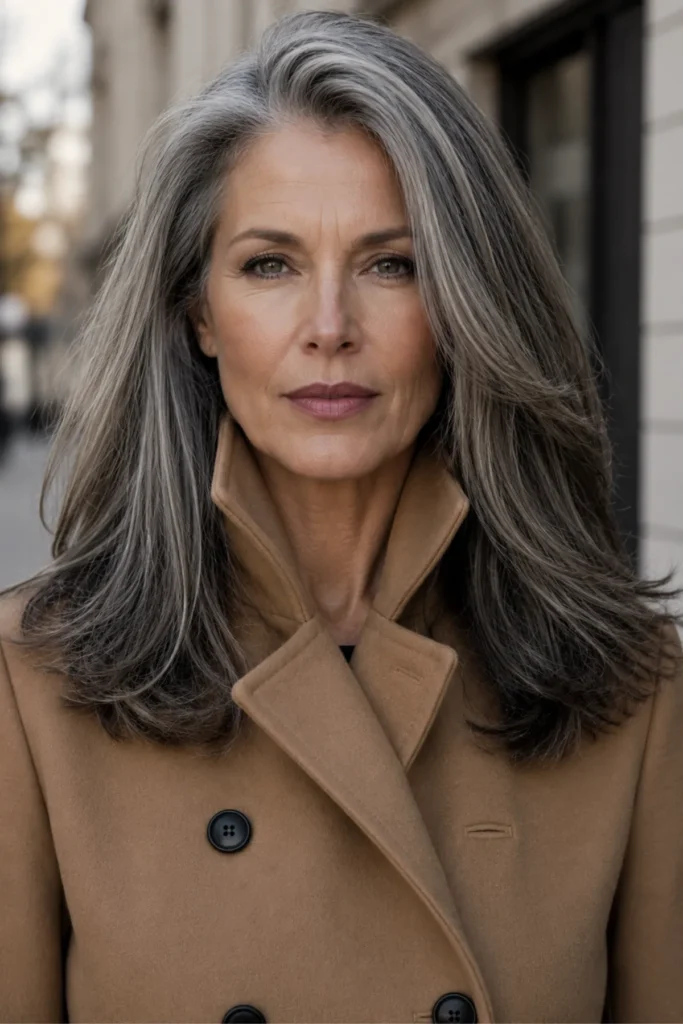
For women with genuinely thick hair, long hair can feel exhausting because of sheer weight and volume. The answer is interior layering, which removes bulk from underneath and mid-length while leaving the surface and ends full. The ends stay blunt or close to blunt, so the overall look retains body. The hair moves, breathes, and dries faster, without losing the length or the fullness that made it worth keeping long.
BEST FOR
- Thick or very dense gray hair
- Rectangular and oval faces
- Women who want length but less weight
Why It Works: Interior layers are invisible from the outside but remove significant weight from within the hair mass, making long thick hair feel dramatically lighter.
Styling Tip: This cut dries well naturally but also responds to a blow-dry with a large paddle brush. If you use heat, apply a heat protectant first.
Salon Tip: Ask for “long layers with interior thinning to remove weight from underneath, blunt ends left intact. I want less bulk, not less length.”
Maintenance Level: Low-medium. Trim every 10 to 12 weeks.
25. The Sleek Straight Long Cut
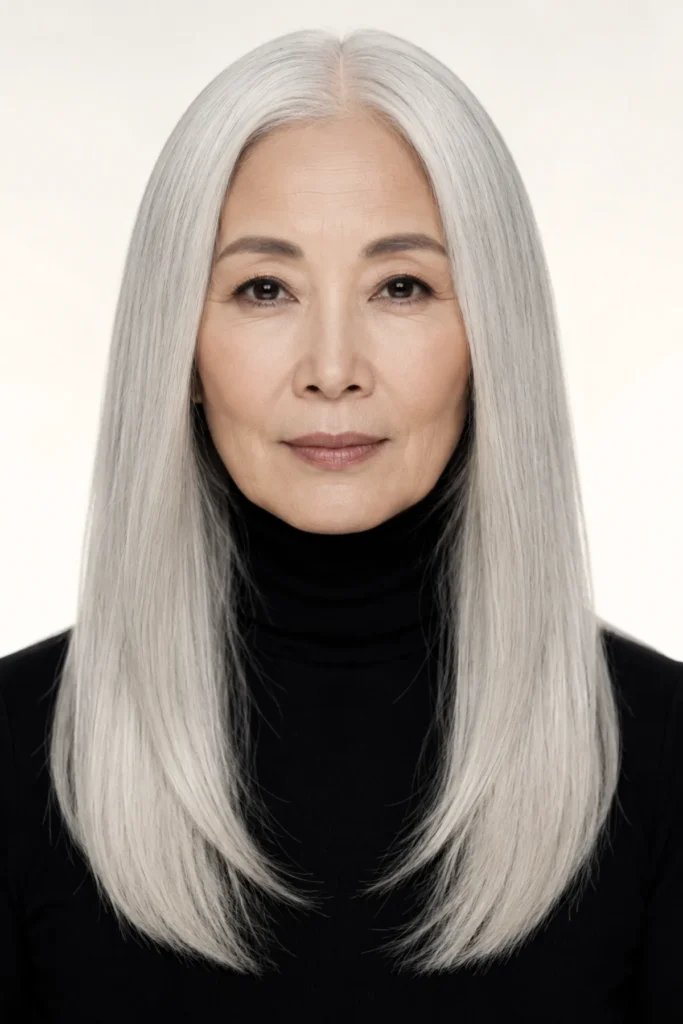
This cut works for one specific profile: women with naturally straight, fine-to-medium hair who are willing to spend ten minutes blow-drying and who find satisfaction in a very clean, precise result. A center part, smooth finish, no visible layers from the outside, past the collarbone. The entire visual interest comes from the silver-white color variation across straight strands. It is a bold choice in its restraint.
BEST FOR
- Naturally straight hair
- Oval faces
- Women who want a sleek, precise look
Why It Works: On truly straight fine-to-medium hair, sleek long cuts display the color variation of natural silver and white better than any layered style, because nothing breaks up the light across the surface.
Who Should Reconsider It: Thick or coarse hair will not stay smooth without constant effort. Wavy or curly hair will not stay straight. This is a high-maintenance style for the wrong hair types.
Styling Tip: Blow-dry with a paddle brush in sections, always brushing downward. A small amount of shine serum on the ends is all the product this needs.
Salon Tip: Ask for “a long straight cut with a center part, no visible layering, and possibly a few invisible interior layers purely for movement, not texture.”
Maintenance Level: High. Requires regular blow-drying to look right.
26. Long Curly Layers
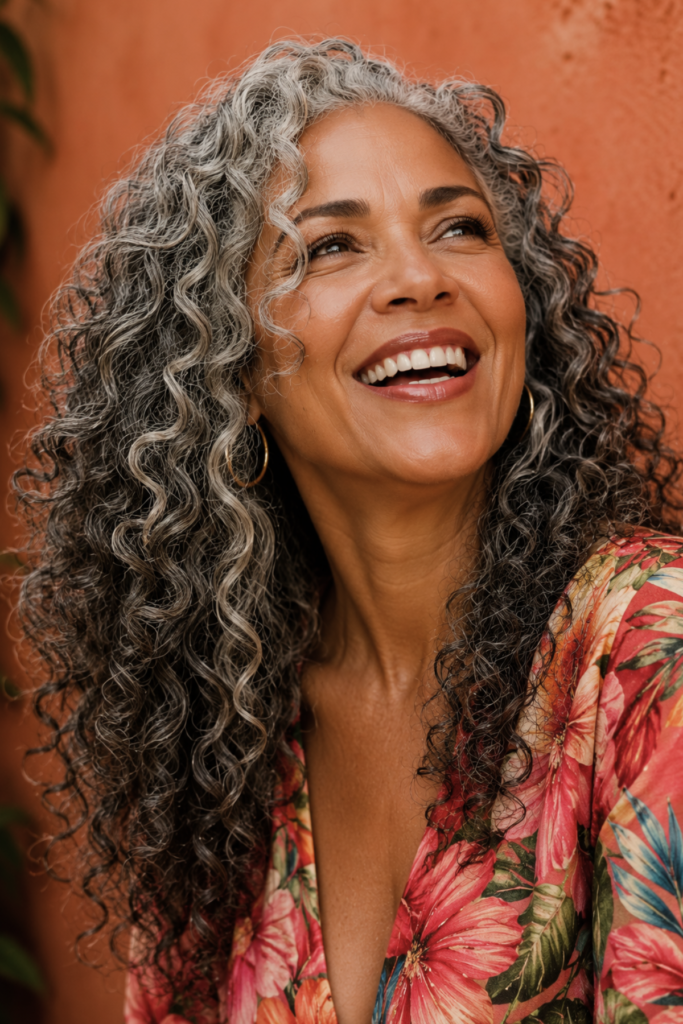
Naturally curly hair requires its own approach to layering: the layers need to be cut while the hair is dry, or at least with the curl pattern fully accounted for, because curly hair contracts significantly when it dries. Long curly layers for gray or silver curls are about giving each curl spiral enough room to form fully rather than being weighed down by the length above it. When it works, the result is voluminous and defined without needing much product.
BEST FOR
- Naturally curly hair, all types
- Heart and oval faces
- Women embracing their gray curls
Why It Works: Removing length-weight from curly hair allows the curl to contract and spring naturally, which is what creates the defined, full look. Weight is what kills curls.
Styling Tip: Apply a curl-defining cream to soaking-wet hair in sections, then diffuse on medium heat or air dry. Do not brush or comb after applying product.
Salon Tip: Ask for “long curly layers cut dry, or at least with the curl pattern accounted for. I need layers placed for where the curl forms, not where the hair falls straight.”
Maintenance Level: Low-medium. Curly cuts grow out more gracefully than straight cuts.
27. The Feathered Long Cut
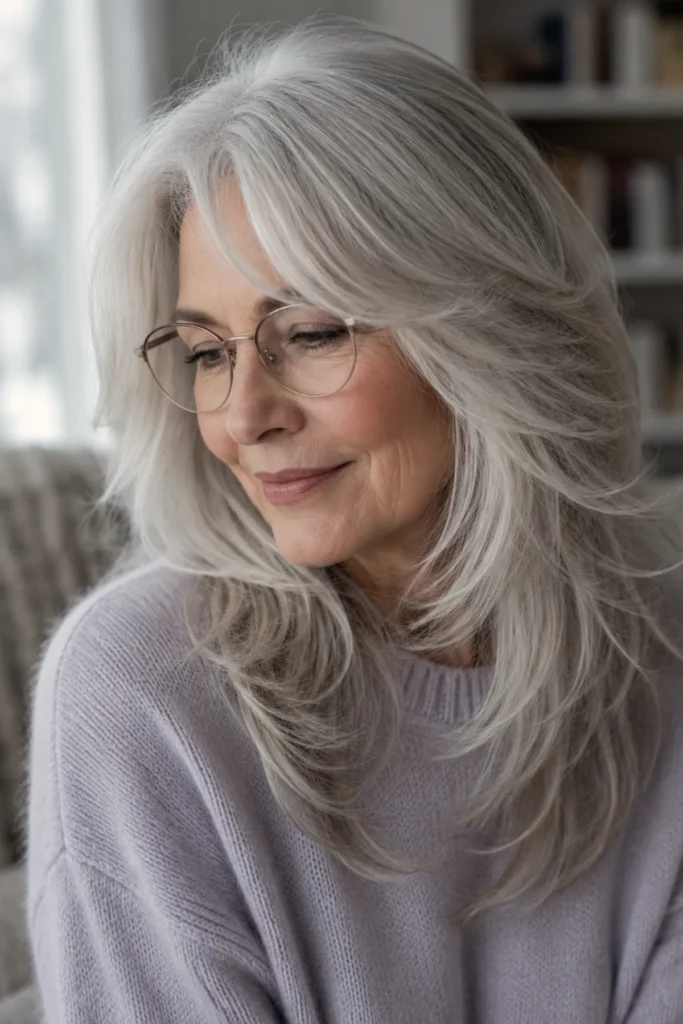
The feathered long cut uses soft, tapered layers throughout the length to create an airy, lightweight quality. The individual strands are slightly thinned at the ends rather than cut straight across, which gives long fine hair a floating, light quality it does not have when cut bluntly. For fine silver hair especially, feathering can make the difference between hair that looks sparse and hair that looks deliberately ethereal.
BEST FOR
- Fine or very light silver hair
- Oblong and oval faces
- Women who want length without weight
Why It Works: Feathering removes mass from the ends without removing length, so fine hair looks like it has more of it rather than less.
Styling Tip: A very light volumizing spray on damp roots before air-drying gives the feathered layers more lift. Avoid heavy creams or serums, which will mat the layers together.
Salon Tip: Ask for “a feathered long cut with tapered, airy ends rather than a blunt hem. The ends should feel lighter than the rest of the length.”
Maintenance Level: Low. Feathered cuts grow out naturally without looking overgrown.
Best Haircuts for Women Over 60 by Face Shape
Not sure which section above applies to you? Find your face shape here and go directly to the styles most likely to suit it.
Oval Face Shape
Oval faces are the most versatile for haircuts: almost nothing is genuinely off-limits. Your best guide is hair density and lifestyle rather than shape. Strong options across lengths: the Disconnected Bob (#04) for a modern short choice, the Asymmetrical Lob (#14) for medium length with directional interest, the Blunt Collarbone Cut (#12) if your density is good, and Soft Layers on Long Hair (#20) if you want length.
Round Face Shape
Round faces do best with cuts that add height at the crown or create diagonal lines across the face. The Crown-Volume Bob (#05) builds the height round faces need. The A-Line Bob (#17) adds a slimming diagonal at medium length. The Long Layered Cut for Thick Hair (#24) manages volume while adding length. Avoid cuts with width at the sides; the Disconnected Bob (#04) with its longer front panels is also worth considering.
Square Face Shape
Square faces have a defined, angular jaw, and the most flattering cuts soften that line with movement or length. The Short Shag with Fringe (#06) relaxes a square jaw with its undone texture. The Side-Parted Shaggy Lob (#13) creates diagonal movement that draws the eye inward. The Wolf Cut at Shoulder Length (#19) adds volume away from the jaw. The Medium-Length Shag (#15) is another strong choice.
Heart-Shaped Face
Heart faces are widest at the forehead and narrowest at the chin, so cuts that add width lower down work best. The Layered Bob with Face-Framing Pieces (#16) adds fullness at cheek level. The Side-Parted Shaggy Lob (#13) directs movement toward the jaw rather than the forehead. Romantic Waves on Long Hair (#23) and the Wolf Cut at Shoulder Length (#19) both add volume in the right places.
Oblong and Long Face Shape
Long face shapes benefit from cuts that add width at the sides and reduce apparent vertical length. The Full Fringe Lob (#22) is the most effective single adjustment for oblong faces. The Short Rounded Bob (#09) adds visual width through its curved hem. The Wavy Bob (#18) adds horizontal volume through wave. The Textured Crop (#02) and Crown-Volume Bob (#05) both work well at shorter lengths.
Best Haircuts for Women Over 60 by Hair Texture
Fine or Thinning Hair
Fine hair needs volume at the root and lightness at the ends. The Crown-Volume Bob (#05) is the most specifically designed cut for thinning crowns in this guide. The Soft Layered Pixie (#01) provides scalp coverage with movement. The Soft Layered Bob (#10) works at medium length. The Feathered Long Cut (#27) is the only long option that does not require significant density to look good. Avoid the Blunt Collarbone Cut (#12) if your density is low.
Thick Hair
Thick hair needs weight removed from within, not just from the ends. The Textured Crop (#02) handles thick short hair well with its choppy interior layers. At medium lengths, the Medium-Length Shag (#15) and the A-Line Bob (#17) both manage volume without fighting it. For long thick hair, the Long Layered Cut for Thick Hair (#24) is the clearest solution.
Gray or Silver Hair
Gray hair is structurally coarser, more porous, and drier than pigmented hair, meaning it absorbs moisture unevenly and can frizz at the surface even when it is not damaged. Cuts that work with this texture: the Wash-and-Wear Pixie (#07), the Medium-Length Shag (#15), the Side-Parted Shaggy Lob (#13), and Romantic Waves on Long Hair (#23). All four are compatible with air drying, which matters because heat-drying porous gray hair repeatedly accelerates dryness.
Naturally Wavy Hair
Wavy hair benefits most from cuts that account for where the wave forms, not where the hair lands when wet. The Wavy Bob (#18) is the most dedicated expression of this principle. The Side-Parted Shaggy Lob (#13) uses the wave as part of its texture. Romantic Waves on Long Hair (#23) is the best long option. The Wolf Cut at Shoulder Length (#19) also works well with natural wave.
Naturally Curly Hair
Curly hair after 60 often changes pattern, becoming looser or more erratic, and tends to dry out more. Long Curly Layers (#26) is the most dedicated curly option in this guide. The Medium-Length Shag (#15) gives curls room to form through its feathered structure. The Short Shag with Fringe (#06) works at shorter lengths for looser curl patterns. The universal rule: ask your stylist to cut your curly hair dry.
How to Style These Cuts at Home
Tools Worth Having (and Tools Worth Skipping)
Worth owning: a wide-tooth comb for detangling wet hair, a microfibre towel (far gentler than regular towels on fine or gray hair), a diffuser attachment for your existing dryer, and a medium-barrel round brush if you blow-dry. That is the core kit that handles almost every cut in this guide.
Worth skipping: fine-tooth combs on wet hair (they cause breakage on fine strands), high-heat flat irons used daily (gray and porous hair is more vulnerable to heat damage), and bristle brushes on wavy or curly hair when wet (they disrupt the wave pattern before it sets).
Products That Actually Help Fine or Gray Hair
For fine hair: a lightweight volumizing mousse applied at the root before drying, nothing heavy at the ends. For gray hair: a leave-in conditioner formulated for porous or color-treated hair makes a real difference in frizz and texture. A toning shampoo used for five to seven minutes every one to two washes counteracts the yellow tones that white and silver hair picks up from mineral deposits in water and environmental exposure. For both types: a small amount of a light shine serum on the ends after drying adds gloss without weight.
The 5-Minute Styling Method for Most Cuts Here
Squeeze out excess water with a microfibre towel rather than rubbing. Apply one product to damp, not soaking-wet, hair: a curl cream for wavy and curly cuts, a lightweight mousse for fine cuts, a leave-in conditioner for gray or coarse hair. Use your fingers or a wide-tooth comb to set the direction of the layers. Air dry or diffuse on low heat. That is the whole routine. Most of the cuts in this guide are designed to look good without further intervention.
Maintenance Guide
How Often to Trim Each Cut Type
| Cut Type | Recommended Trim Frequency | Why |
|---|---|---|
| Pixie / Crop / Micro Pixie | Every 4 to 6 weeks | Shape deteriorates quickly without trimming |
| Bob, chin-length or rounded | Every 6 to 8 weeks | Blunt or curved ends make split ends visible |
| Lob or medium length | Every 8 to 10 weeks | Layers grow out gradually, not suddenly |
| Long with layers | Every 10 to 12 weeks | Weight and split ends are the main concerns |
Short cuts require the most salon time annually because the shape degrades more visibly as they grow. If frequent appointments are a barrier, medium-length and long layered cuts are genuinely more economical to maintain. One honest note: skipping trims does not save money if the hair ends up looking neglected, because the next appointment becomes a correction rather than a maintenance trim.
How to Extend Time Between Cuts
Dry shampoo at the roots can buy an extra week on short styles by restoring volume that flattening loses. For layered cuts at any length, styling in a slightly different direction every few days delays the moment the layers start to look overgrown. For medium and long cuts, a single dusting of the ends at home with small hair scissors removes the most visible split ends without changing the shape.
Gray Hair Maintenance Specifics
Gray and white hair lacks the melanin that helps retain moisture, so it benefits from a deep conditioning treatment every two to three weeks. A purple or blue toning shampoo used for five to seven minutes every one to two washes counteracts the yellow tones that silver hair picks up from water minerals and environmental exposure. The American Academy of Dermatology notes that gray hair tends to have higher porosity than pigmented hair, which means it absorbs moisture quickly but loses it equally fast. The solution is sealing with a light conditioner after every wash.
What to Tell Your Stylist
The most common miscommunication in the salon is “I want it shorter but not too short.” That phrase means something different to every stylist, which is how people end up with pixies they did not want. What actually helps is specificity.
Three Things to Say Before the Cut Starts
First: describe your hair honestly, specifically its density and how it behaves when you let it air dry. “My hair is fine and gets flat at the crown” or “My hair is thick and takes forever to dry” changes what a stylist will do before scissors touch your head.
Second: tell them how much time you spend styling on a typical morning. Not what you are willing to do once a week. What actually happens at 7am. This determines whether the cut will work in real life.
Third: name the thing you most want to avoid. “I do not want to lose my ability to pull it back” or “I have had three bobs in a row and they all ended up looking the same” are both useful constraints. Stylists need to know what not to do as much as what to do.
How to Use This Article in Your Salon Appointment
Every style in this guide includes a Salon Tip: a single sentence you can read directly to your stylist or show on your phone. The combination of a specific verbal brief and a reference image is the most effective way to close the gap between what you picture and what you leave with.
One more note: if a stylist suggests something different from what you came in requesting, it is worth asking why rather than immediately agreeing or refusing. Sometimes they see something in your hair’s behavior that genuinely changes the picture. Sometimes they are defaulting to what they know. Understanding which it is takes about thirty seconds of conversation.
Frequently Asked Questions
What is the most flattering haircut for a woman over 60?
There is no single answer, but the Soft Layered Bob (#10) and the Side-Parted Shaggy Lob (#13) come closest to a universal option for this demographic. They work across the widest range of face shapes and hair densities, and both grow out gracefully. The most important variables are your hair density and face shape. Jump to the face shape section or the hair texture section above to narrow it down quickly.
Should women over 60 have short or long hair?
Neither is more flattering by default. Short cuts tend to suit women with fine or thinning hair because they reduce the pull of gravity on lighter strands. Long cuts work well for thicker hair when layers are in place. The more useful question is what your hair does naturally and which length works with that rather than against it.
Do bangs make women over 60 look older or younger?
The style of bang matters more than the fact of having one. Wispy bangs and curtain bangs tend to soften the forehead and create a flattering frame without adding visual weight. A full fringe, as in the Full Fringe Lob (#22), suits oblong faces specifically and can look very current when the cut supports it. Heavy, blunt fringes that sit flat across the forehead can emphasize fine lines on the wrong face shapes.
What is the best haircut for thinning hair over 60?
The Crown-Volume Bob (#05) is the most specifically designed cut in this guide for thinning crowns. At short length: the Soft Layered Pixie (#01). At medium length: the Soft Layered Bob (#10) and the Layered Bob with Face-Framing Pieces (#16). For longer hair: the Feathered Long Cut (#27). Avoid the Blunt Collarbone Cut (#12) and the Micro Pixie (#03) on fine hair; both require density to land correctly.
How often should women over 60 get a haircut?
Pixies and crops need a trim every 4 to 6 weeks to maintain their shape. Chin-length bobs need trimming every 6 to 8 weeks. Lobs and medium-length cuts can go 8 to 10 weeks. Long layered cuts can stretch to 10 to 12 weeks. See the maintenance table above for detail.
Are there hairstyles that tend to work less well for women over 60?
A few combinations come up frequently. Very heavy blunt bobs on fine hair tend to look flat and sparse at the hemline. Very long single-length hair with no layers can weigh the face down. Very short crops with no texture on round faces can emphasize roundness without the softening effect of layers. None of these are absolute rules, and none apply to everyone.
Is it possible to have stylish long hair after 60?
Yes, with the right cut. The mistake is not the length itself; it is the absence of structure. Long hair with layers, whether soft, feathered, shaggy, or curly, looks deliberate and current. Long hair with no layering tends to look flat and heavy on hair that has lost some density. If you are committed to your length, the layer conversation with your stylist is the most important one you will have.
How do I transition to gray hair without ending up with a bad haircut?
The cut matters as much as the color process. Gray hair has a different texture from pigmented hair, and a style that looks good on pigmented hair may not translate. Cuts that work well with gray texture include the Side-Parted Shaggy Lob (#13), the Wolf Cut at Shoulder Length (#19), the Wash-and-Wear Pixie (#07), and Romantic Waves on Long Hair (#23). All four work with gray’s natural behavior rather than against it. For the full guide on transitioning color.
Final Thoughts
The idea that there is a correct age to cut your hair short, or a correct length to keep for looking appropriate, is not rooted in what actually looks good. The 25 cuts in this guide range from the close-cropped Micro Pixie to feathered lengths past the collarbone, and all of them are here because they work well for the specific way hair behaves after 60.
The two things that will do more for you than any specific style: finding a stylist who listens and cuts for your actual hair, and being honest with yourself about how much time you are genuinely willing to spend styling. Match those two things to any of the cuts above and the result will be one you can live with past the first week.
Save this article before your next appointment. Show your stylist the Salon Tip from whichever style catches your eye. That one sentence is worth more than five minutes of explanation in the chair.
Related Hairstyles:
